📢 Update: You can now contact us by landline 02 6685 6722 or Shop Mobile 0490 078 621 — available for both calls and texts.
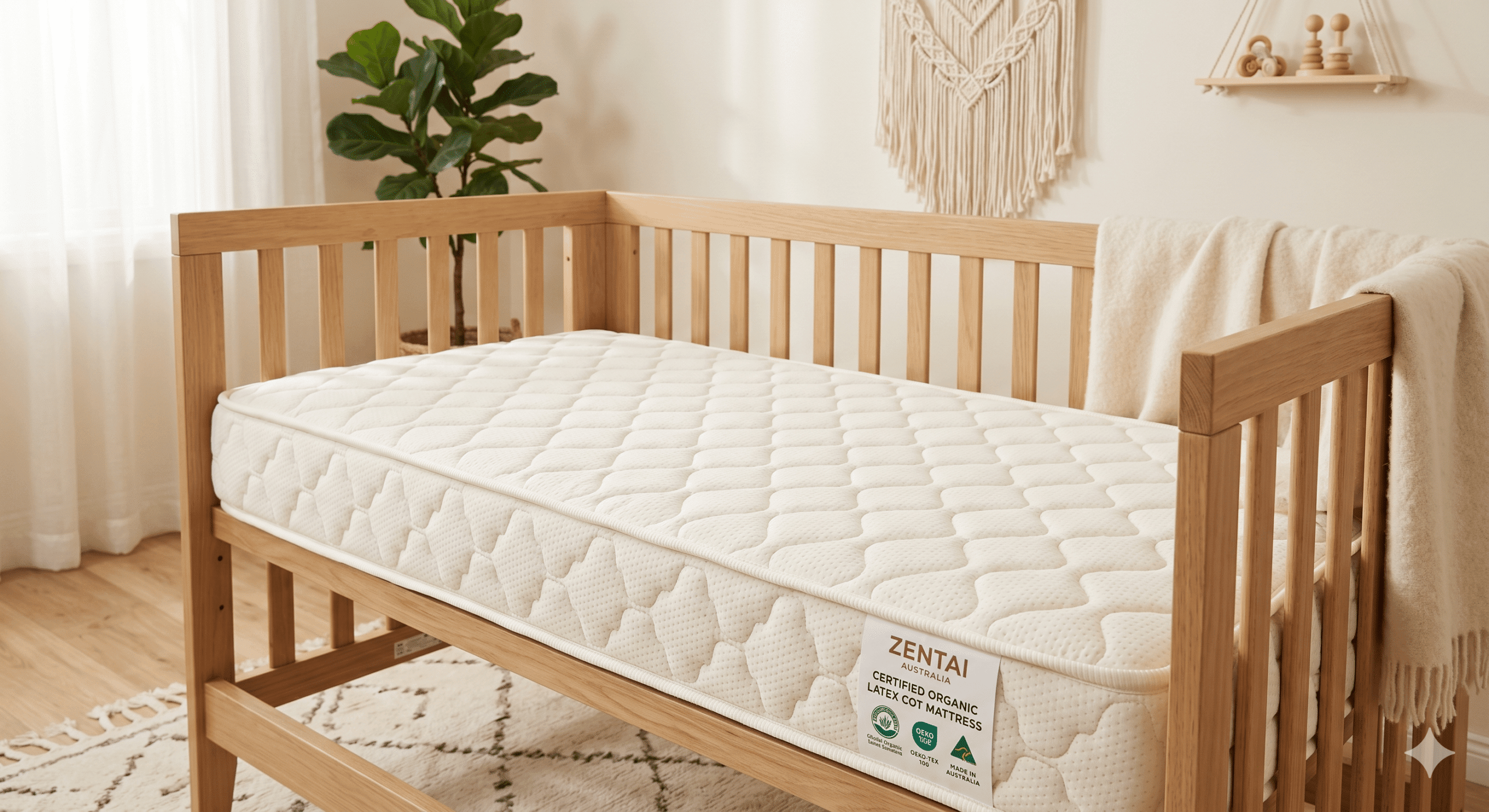
Organic cot mattress is one of the most important purchases you will make before your baby arrives, and it is worth taking the time to understand exactly what you are buying. Your newborn will spend up to 16 hours a day sleeping, which means they are in direct contact with the mattress for longer than any adult spends in bed. During those hours, the materials inside the mattress affect air quality, body temperature, chemical exposure, and spinal support. Getting this decision right from the start gives your baby the safest and healthiest possible foundation for sleep.
This guide covers everything Australian parents need to know about choosing an organic cot mattress, from understanding certification standards to identifying greenwashing, comparing materials, and knowing what safety guidelines actually require. Whether you are shopping for your first baby or replacing an existing mattress, the information here will help you make a confident and well-informed decision.
Conventional foam cot mattresses are typically made from polyurethane, a petroleum-derived material that can off-gas volatile organic compounds into the air your baby breathes during sleep. Many also contain chemical flame retardants, formaldehyde-based adhesives, and synthetic fillers that are not subject to the same testing standards applied to certified organic materials. An organic cot mattress is manufactured using natural raw materials that have been independently verified to meet strict limits on harmful substances, giving parents a documented and verifiable alternative to conventional synthetic products.
Babies breathe at a faster rate than adults and spend proportionally more time in close contact with their sleep surface, which makes the chemical content of a cot mattress a genuine health consideration rather than a marketing preference. Choosing an organic cot mattress that carries third-party certification is the most reliable way to reduce your baby’s exposure to harmful chemicals during the hours when they are most vulnerable and least able to move away from a problematic surface.
Not all organic claims carry the same weight, and the label ‘natural’ is completely unregulated in Australia, meaning it can appear on any product regardless of what it actually contains. The only reliable way to verify the content and safety of a cot mattress is through independent third-party certification from a recognised body that publishes its testing methodology and allows consumers to verify certificates directly. Understanding which certifications matter, and what each one actually tests, is essential knowledge before you make any purchase decision.
GOLS, the Global Organic Latex Standard, is the most rigorous certification for a latex core and requires that at least 95 percent of the raw material is certified organic, while also covering the full production chain from plantation to finished product. Oeko-Tex Standard 100 Class 1 tests the completed mattress against more than 100 harmful substances at thresholds specifically calibrated for products used by babies and infants, making it the most directly relevant safety standard for an organic cot mattress. ECO Institut certification from Germany tests for chemical emissions in the air directly above the mattress, which is a real-world measure of what your baby actually inhales during sleep. GOTS, the Global Organic Textile Standard, applies to the fabric cover and verifies that any organic cotton content meets certified organic requirements throughout the supply chain, helping parents choose an organic cot mattress with confidence.
The core material is the foundation of any organic cot mattress and has the greatest influence on support, durability, breathability, and chemical content. The two most common options available in Australia are certified organic latex and certified organic cotton or wool, each with distinct properties that suit different sleeping environments and parental priorities.
Organic latex is the most widely chosen material for modern certified cot mattresses because it offers a combination of resilience, natural breathability, and resistance to dust mites and mould without the need for added chemical treatments. Its open-cell structure allows air to circulate freely through the mattress, which helps regulate your baby’s temperature throughout the night and reduces moisture buildup. The material is also responsive in a way that supports your baby’s developing spine while remaining firm enough to meet Australian sleep safety guidelines.
Organic cotton and wool fills are the more traditional choice and have been trusted for generations across many cultures for infant sleep. Pure cotton futon-style cot mattresses breathe exceptionally well, regulate temperature naturally through the seasons, and contain no petroleum-derived content whatsoever. At Zentai Living, our organic cot mattress combines a GOLS-certified organic latex core with a certified organic cotton cover, so every layer of the product is independently verified and traceable back to its source material.
Australian paediatric sleep safety guidelines are consistent and clear: a cot mattress must provide a firm, flat sleeping surface with no soft padding, pillow tops, or contouring materials that could allow a baby’s face to sink into the surface. A surface that is too soft reduces airflow around the face and increases the risk of re-breathing exhaled air, which is a recognised factor in unsafe infant sleep environments. These guidelines apply equally to organic and conventional mattresses, meaning that certification alone is not sufficient if the mattress does not also meet firmness standards.
A quality organic cot mattress made from certified organic latex is manufactured with a specific ILD (Indentation Load Deflection) rating that ensures the surface is firm to the touch while still providing the gentle pressure relief a baby needs at contact points like the shoulders and hips. The mattress must also fit snugly inside the cot with no gaps greater than 25mm between the mattress edge and the cot frame, as larger gaps create an entrapment risk for small hands, feet, and in the worst cases, heads. Always measure your cot carefully before ordering, as Australian cot dimensions are not fully standardised across all manufacturers and models.
The baby product market is one of the most heavily greenwashed retail categories in Australia, with words like ‘natural’, ‘eco’, ‘green’, and ‘chemical-free’ appearing routinely on products that carry no independent certification to support those claims. Genuine organic certification requires a manufacturer to submit their product and production process to ongoing third-party audits, which is a significant commitment that separates verified claims from marketing language. Learning to read past the packaging and ask the right questions is one of the most valuable skills a parent can develop when shopping for infant sleep products.
The most straightforward test is to ask whether you can verify the certification directly on the certifying body’s website, since GOLS certificates are searchable through Control Union and Oeko-Tex certificates are searchable at oeko-tex.com using the certificate number printed on the product label. A genuine organic cot mattress from a reputable manufacturer will always be able to provide the certificate number, the certifying body’s name, and the scope of what was actually tested. If a brand cannot supply this information clearly and directly, the organic claim should be treated as unverified marketing rather than independently confirmed fact.
It is also worth considering where the mattress is manufactured. Zentai Living has made certified organic sleep products by hand in Byron Bay since 1981, which means the production process is local, traceable, and subject to Australian quality standards throughout. An imported product claiming organic status carries a longer and less transparent supply chain, which makes independent certification even more critical as the primary form of verification.
A well-made organic cot mattress constructed from certified organic latex should maintain its shape, firmness, and support properties for the full period your child uses a cot, which typically runs from birth through to around three years of age. Organic latex is particularly durable because it resists compression set, meaning it returns to its original thickness and firmness after extended periods of use rather than gradually flattening the way that polyurethane foam does. This durability is not just about comfort; a mattress that maintains consistent firmness throughout the cot years continues to meet sleep safety guidelines rather than degrading below acceptable levels partway through your baby’s infancy.
Polyurethane foam, by comparison, can begin to lose firmness and structural integrity within 18 to 24 months, particularly in lower-priced products where foam density is reduced to keep costs down. When foam degrades, the mattress can develop uneven areas that compromise both safety and comfort, and at that point the mattress needs to be replaced regardless of how much useful life might appear to remain. Calculating cost per year of safe use, rather than comparing sticker prices, consistently narrows the gap between a certified organic latex mattress and a conventional foam alternative.
When you are ready to make a purchase, applying a consistent checklist to any organic cot mattress you consider will help you cut through marketing claims and focus on the factors that genuinely matter for your baby’s safety and wellbeing. Start with certifications and work outward from there, using the certifying body’s website to verify each claim before you spend any money.
Confirm that the mattress carries GOLS certification for the latex core, Oeko-Tex Standard 100 Class 1 for the finished product, and ECO Institut testing for chemical emissions. Check that the mattress is described as firm and flat, not cushioned or pillow-topped, and verify that the dimensions match your cot with less than 25mm of gap on each side. Ask the manufacturer directly where the mattress is made, how long they have been producing certified organic sleep products, and whether the certification documents are available for you to view before purchase.
At Zentai Living, our organic cot mattress meets every point on this checklist and has been handmade in Byron Bay using GOLS-certified organic latex and certified organic cotton since 1981. Every certification is verifiable directly with GOLS, Oeko-Tex, and ECO Institut, and our team is available to answer any questions about materials, construction, or safety before you commit to a purchase.
Your baby deserves the best possible sleep environment from their very first night, and a genuine organic cot mattress backed by independent certification, proven materials, and Australian craftsmanship is the most reliable way to provide exactly that. Start with verified certifications, confirmed firmness, and a manufacturer whose track record you can trust, and you will have the foundation right from day one.
Your baby’s sleep environment plays a vital role in their comfort, development, and wellbeing. Choosing a high-quality organic cot mattress made from certified organic materials can help create a safer, healthier, and more breathable sleep space from day one.
At Zentai Living, our Certified Organic Latex Cot Mattress is handcrafted using premium GOLS-certified organic latex and certified organic cotton to provide exceptional support, durability, and peace of mind for Australian families.
Whether you’re preparing your nursery or upgrading your baby’s sleep setup, investing in a natural mattress is an investment in healthier sleep and long-term comfort.
Shop Our Certified Organic Latex Cot Mattresses Today and Discover the Difference Natural Sleep Can Make.