📢 Update: You can now contact us by landline 02 6685 6722 or Shop Mobile 0490 078 621 — available for both calls and texts.
Written by Michael, Founder of Zentai Living.
Mattress depth is one of the least explained decisions in buying an organic latex mattress. If you’ve spent any time comparing our range, you’ve probably noticed we sell the same mattress in three different heights: 18cm, 23cm and 26cm. It’s a fair question to ask why — and an even fairer one to ask which is actually right for you.
Unlike firmness, which is a feel you choose, mattress depth is a structural decision: it changes how many latex layers are doing the work, how adjustable the mattress is over its lifetime, and how it sits in your room. This guide walks through what actually changes between the three profiles, so you’re choosing based on construction, not guesswork.
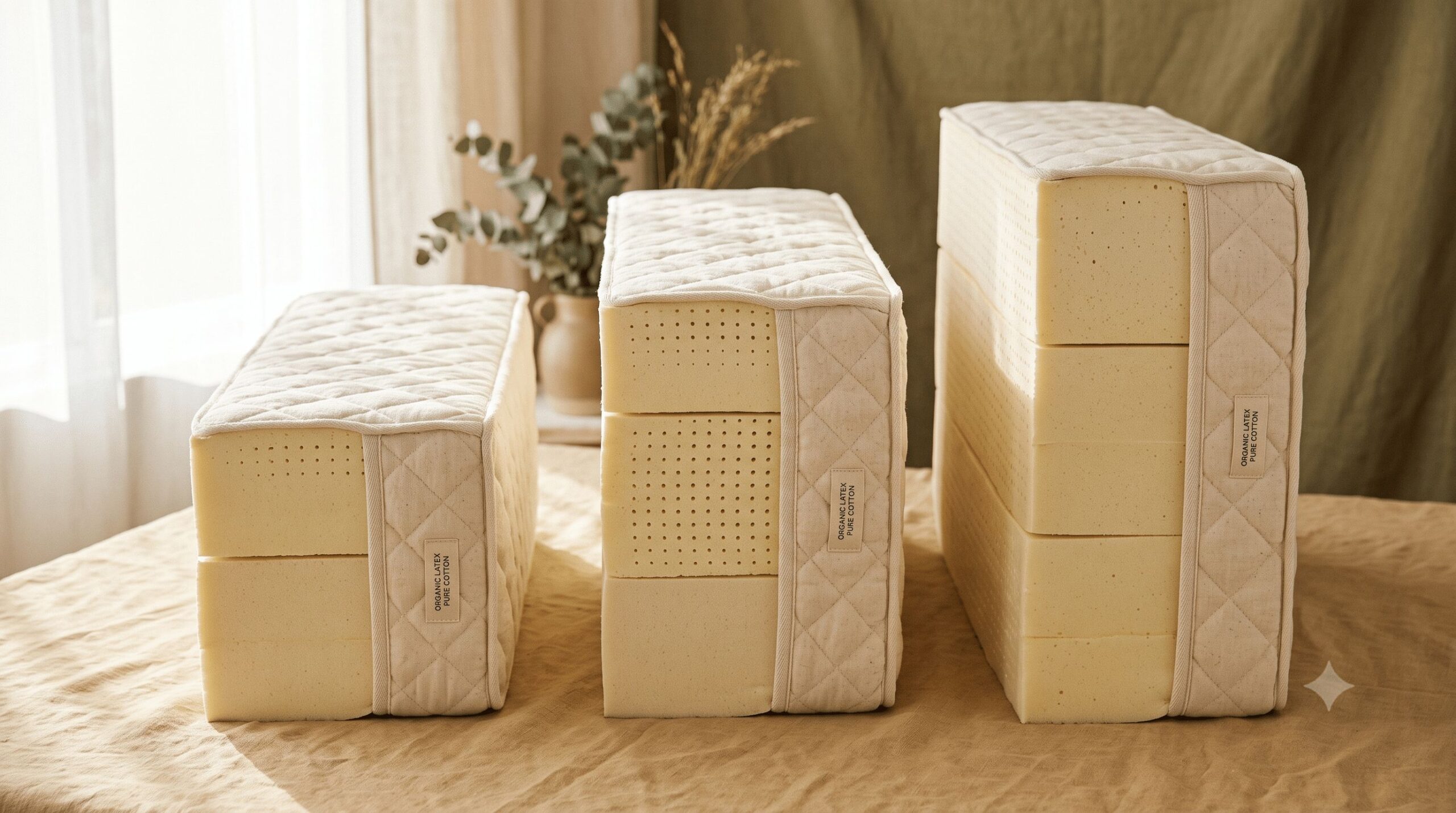
Every Zentai mattress is built from GOLS-certified organic latex layers that can be flipped, rotated or rearranged to fine-tune feel and even out wear over the years. The depth you choose determines how many of those layers you’re working with:
Quilting adds a little more on top: on the 23cm and 26cm mattresses, wool or cotton quilting adds roughly 3cm to the core height, and a non-quilted finish sits closer to the base figure. It’s worth checking the current quilting options on the product page, since this affects the exact height you’ll end up with.
| 18cm Duo-Layer | 23cm Tri-Layer | 26cm Tri-Layer | |
|---|---|---|---|
| Layers | 2 adjustable layers | 3 layers (firm/medium/soft) | 3 layers (firm/medium/soft) |
| Comfort range | Medium to Firm | Soft-Medium to Medium-Firm | Plush to Medium-Firm |
| Feel | Sleeker, more direct support | Balanced, all-round | Deeper, more cushioned |
| Best suited to | Buyers who prefer a firmer, lower-profile bed | Buyers who aren’t sure, or want maximum adjustability | Buyers who want a plusher feel without losing support underneath |
| Guide price | From $1,130 | From $1,495 | From $1,795 |
All three are handcrafted in Byron Bay from the same certified organic latex and come with the same quilting choices (organic cotton or organic wool). The difference is entirely in layer count and overall depth — the certifications, materials and adjustability philosophy don’t change.
Choosing the right mattress depth comes down to a few practical things worth weighing, rather than a single “right answer”:
If you like a firmer, more direct sleep surface and prefer a lower bed height — for a low bed frame, a room with a low ceiling, or simply the aesthetic — the 18cm duo-layer is worth starting with. It’s also the lightest of the three to lift and rotate.
If you’re not sure what you want, or you know your preferences might shift over time (a partner with different comfort needs, a firmness that might need adjusting after the first few months), the 23cm tri-layer gives you the most combinations to work with. It’s the profile we recommend most often as a starting point precisely because three layers of different densities can be rearranged more ways than two.
If you want a plusher, more enveloping feel without giving up the support structure underneath — a deeper “sink-in” sensation some buyers associate with hotel beds — the 26cm is built for that, while still offering a Medium-Firm option within its range for those who want more structure.
Body weight and sleep position both interact with these choices, but they don’t override them: a side sleeper who likes a firm feel and a side sleeper who likes a plush feel can each be well served by different depths in this range. The comfort-level options within each depth (see the product pages) matter as much as the depth itself.
If you want a single default recommendation: the 23cm tri-layer is the one we’d point most first-time latex buyers toward. It sits in the middle of the range on price, offers the widest comfort span (soft-medium through to medium-firm), and — because it’s a three-layer build — gives you the most room to adjust if your first impression after a few weeks isn’t quite right. It comes with our 10-year guarantee, the same as the 26cm.
That’s a starting point, not a rule. If you already know you sleep hot and firm, or that you’ve always preferred a plush hotel-style bed, the 18cm or 26cm may suit you better from day one.
Within a depth, yes — that’s the entire point of the layered, adjustable construction. Flipping, rotating, or rearranging the layers you already have lets you shift the feel without buying a new mattress. Moving between depths (say, from an 18cm to a 26cm) isn’t a layer-rearrangement — it’s a different product, since the layer count and core structure differ. If you’re genuinely torn between two depths, it’s worth a conversation with us before you order rather than after.
Does a deeper mattress mean a firmer mattress?
No — depth and firmness are separate decisions. The 26cm is our deepest option but has the plushest comfort range of the three, while the 18cm is our shallowest and leans firmer. Choose comfort level and depth independently.
Is the 26cm just the 23cm with extra padding?
Not padding — a deeper supportive core. Both use the same three-density layer construction; the 26cm’s core is built deeper for a more cushioned feel while keeping the same support structure underneath.
Will a deeper mattress need a different bed base or fitted sheets?
It’s worth checking fitted sheet depth if you’re moving from a shallower mattress. For bed bases, our slat compatibility guide covers what to check regardless of which depth you choose.
Which depth is the best seller?
The 23cm tri-layer is the one we recommend most often as a starting point, for the reasons above — but the right choice depends on the feel and bed height you’re after.
Full specifications, current comfort-level and quilting options, and pricing by size are on each product page: