📢 Update: You can now contact us by landline 02 6685 6722 or Shop Mobile 0490 078 621 — available for both calls and texts.
The most common sleep advice focuses on what to avoid: screens, caffeine, late meals, alcohol. Useful, but incomplete. What you actively do in the hour before sleep matters just as much — and two of the most effective pre-sleep practices are among the oldest: shiatsu & yoga.
Both work through the same underlying mechanism. The nervous system has two modes — sympathetic (alert, reactive, fight-or-flight) and parasympathetic (calm, restorative, rest-and-digest). Sleep requires a clear handoff from sympathetic to parasympathetic, and many people who struggle to fall asleep or sleep lightly are simply failing to make that transition fully. Shiatsu and yoga directly facilitate the switch — one through targeted pressure on specific points, the other through breath-led movement and sustained holds.
This guide covers the practice and the products that support it. Both traditions work without equipment. Both work better with the right support.
Your body does not move from wakefulness to sleep the way a computer sleeps — with a single switch. Sleep onset requires a gradual winding down of the sympathetic nervous system and a corresponding activation of the parasympathetic system. Heart rate slows. Cortisol drops. Core body temperature falls. Muscle tension releases.
In the modern Australian evening — screens, work messages, overstimulation until the moment of bed — this transition is repeatedly interrupted. The body is still in a partially activated sympathetic state when you close your eyes. The result is the experience most people describe as “not being able to switch off.”
Both shiatsu and yoga work below the level of conscious effort. You don’t have to convince your mind to calm down — the physical inputs (pressure on specific meridian points, slow breath with long exhales, sustained passive stretches) directly signal the parasympathetic system through the vagus nerve and the proprioceptive system. The body follows.
Shiatsu is a Japanese bodywork practice derived from traditional Chinese medicine. “Shiatsu” translates literally as “finger pressure” — the practitioner applies sustained pressure to specific points along the body’s meridian system, the network of energy pathways identified in Chinese medicine. In a clinical or professional context, shiatsu is delivered by a trained practitioner. For sleep preparation, a self-shiatsu practice using a small number of key points is highly accessible and effective.
The mechanism in Western physiological terms: sustained pressure on specific anatomical points stimulates proprioceptive nerve endings, which communicate with the central nervous system and modulate the autonomic nervous response. Pressure on certain points increases parasympathetic tone — slowing heart rate, reducing muscle tension, and lowering the alertness threshold. For sleep, this is the precise state transition you’re trying to initiate.
Several points have been studied specifically for their effect on sleep quality and anxiety. A pre-sleep shiatsu routine using these points takes less than ten minutes and requires no equipment beyond your own hands — though acupressure tools can extend the pressure and reduce hand fatigue.
Heart 7 (HT7) — The Spirit Gate Location: on the wrist crease, at the ulnar (little finger) side, in the hollow between the wrist bones. Effect: the most studied point for insomnia and anxiety. Stimulating HT7 is associated with reductions in heart rate and cortisol, and improvements in sleep quality in clinical trials. Apply sustained thumb pressure for 1–2 minutes per side.
Pericardium 6 (PC6) — Inner Gate Location: on the inner forearm, three finger-widths up from the wrist crease, between the two central tendons. Effect: regulates the heart rhythm and calms the mind. Familiar to many people through acupressure wristbands for nausea — the same point. Apply firm circular pressure for 1–2 minutes per side before sleep.
Gallbladder 20 (GB20) — Wind Pool Location: at the base of the skull, in the hollows on either side of the spine where the neck muscles meet the occiput. Effect: releases tension in the suboccipital muscles — the group most responsible for the headache-and-neck-tightness sensation of a stressed day. Interlace your fingers behind your head and apply upward thumb pressure into these hollows. Hold for 2–3 minutes with slow breathing.
Kidney 1 (KI1) — Bubbling Spring Location: on the sole of the foot, in the depression just below the ball, approximately one-third of the way from the toes. Effect: described in Chinese medicine as “grounding” — bringing the body’s energy downward from the overactive head. In physiological terms, pressure here stimulates the plantar nerve and has a measurable calming effect. Sustained thumb pressure or a massage ball here for 2–3 minutes per side is an effective sleep ritual addition.
An Mian (Extra Point) — Peaceful Sleep Location: behind the ear, midway between GB20 (at the base of the skull) and the mastoid process (the bony prominence behind the earlobe). Effect: this extra point — outside the main meridian system — is used specifically for insomnia in Chinese medicine. Apply gentle circular pressure with the middle finger for 1–2 minutes per side.
Acupressure mats — a grid of small plastic or natural material spikes applied to a foam or natural latex base. Lying on an acupressure mat for 15–20 minutes before sleep stimulates broad-area pressure points across the back, releasing endorphins and activating the parasympathetic response. The initial sensation is intense and gives way to warmth and deep relaxation — the physiological response most users describe as “melting.” Natural acupressure mats use organic cotton fabric and non-toxic spike materials.
Shiatsu massage balls — firm balls in natural rubber or latex, used for self-massage on the feet, hands, and along the spine (placed on the floor). A natural latex massage ball on Kidney 1 at the end of the day is one of the most accessible self-shiatsu practices available.
Yoga’s effects on sleep are among the best-documented of any non-pharmacological intervention. A consistent pre-sleep yoga practice — even 15–20 minutes — has been shown to reduce time to sleep onset, reduce nighttime waking, and improve subjective sleep quality. The mechanism is the same as shiatsu: yoga practices that emphasise long exhale breathing and passive holds in forward folds and inversions directly increase parasympathetic tone.
The style of yoga matters. Vinyasa and power yoga are stimulating — they raise heart rate and cortisol, the opposite of what sleep requires. Yin yoga, restorative yoga, and specific sequences from hatha yoga targeting the parasympathetic system are what apply here.
Two physiological mechanisms do most of the work in a pre-sleep yoga practice:
Extended exhale breathing — the exhale phase of breathing activates the vagus nerve and reduces heart rate (this is why you slow down after a hard effort by extending your exhale). A 4-count inhale, 6–8 count exhale — maintained through the following poses — initiates the parasympathetic response within minutes.
Passive forward folds and inversions — poses that bring the head below or level with the heart, or that apply gentle compression to the abdomen, stimulate the vagus nerve directly through the stretch receptors in the thoracic and abdominal walls. These poses are the core of a sleep-preparation yoga sequence.
Perform each pose with attention to a slow extended exhale. The sequence is designed to be done on your bed or a mat in low light.
1. Child’s Pose (Balasana) — 3 minutes Kneel, sit back on your heels, and fold forward to rest the forehead on the floor or a folded blanket. Arms extended forward or resting alongside the body. This position applies gentle abdominal compression and places the head below the heart. The forward fold position is inherently calming to the nervous system. Use a bolster under the chest and forehead for full support in a restorative variation.
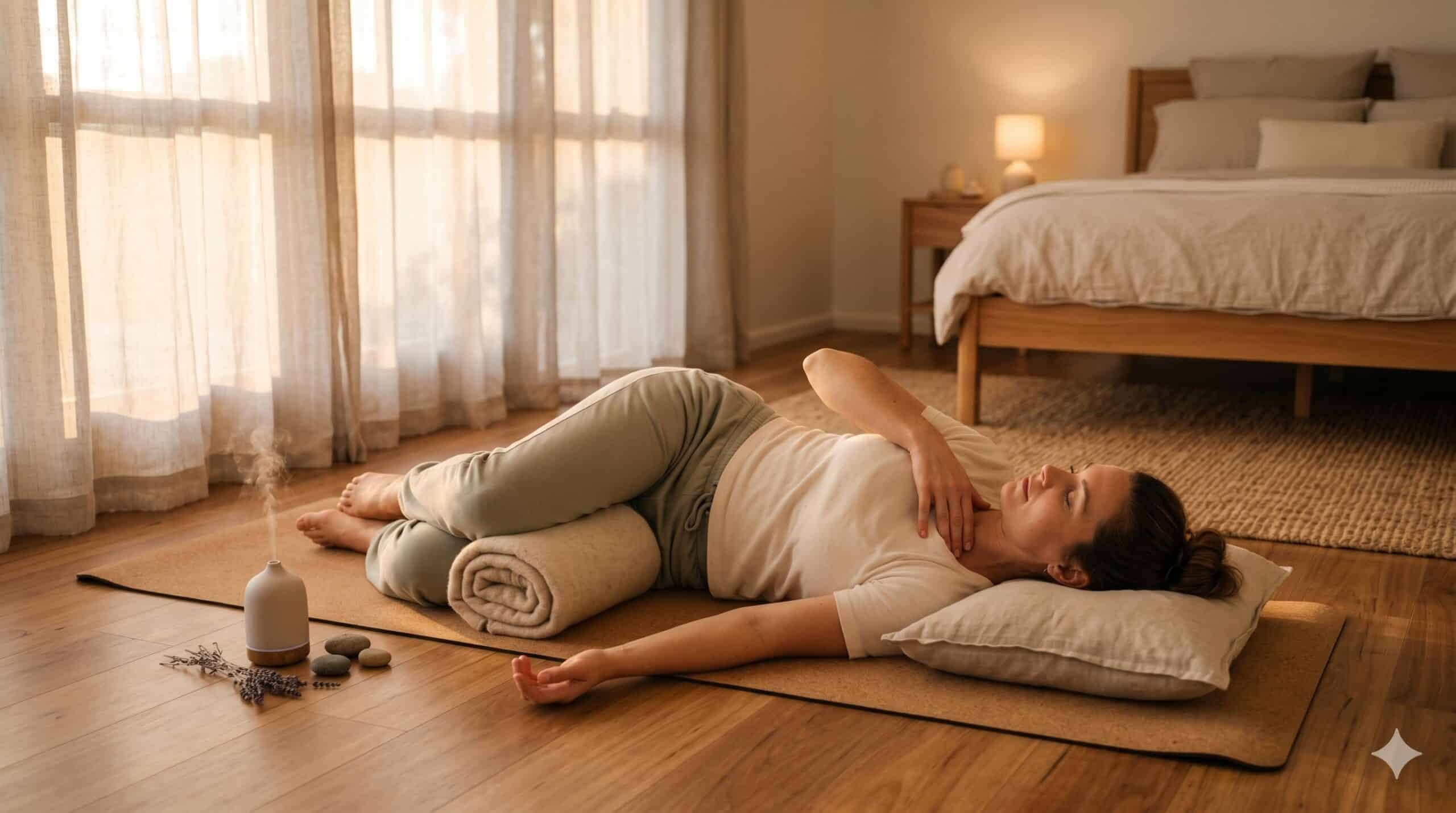
2. Reclined Butterfly (Supta Baddha Konasana) — 4 minutes Lie on your back. Bring the soles of the feet together and allow the knees to fall apart. Place a folded blanket or bolster under each thigh for support — this removes the muscular effort of holding the position and allows the hips to release passively. An eye pillow over the eyes deepens the calming effect. Breathe slowly with emphasis on the exhale.
3. Supine Spinal Twist (Supta Matsyendrasana) — 2 minutes each side Lie on your back. Draw one knee to the chest, then guide it across the body toward the opposite side while extending the same arm to the side. The thoracic spine rotates gently. This pose releases accumulated tension in the paraspinal muscles along the mid and lower back — the muscles that hold the postural load of sitting during the day. Breathe slowly and allow the rotation to deepen passively with each exhale.
4. Legs Up the Wall (Viparita Karani) — 5 minutes Lie on your back with your sitting bones close to a wall, legs extended vertically upward against the wall. This mild inversion returns venous blood from the legs to the core and reduces the sympathetic nervous system activity that keeps legs alert after a day of standing or walking. It is the most reliably calming yoga position in the sleep context, and among the most studied. A bolster under the hips lifts the pelvis slightly and increases the restorative effect.
5. Savasana (Corpse Pose) — 5 minutes Lie flat on your back, legs slightly apart, arms away from the body with palms facing upward. Cover the eyes with an eye pillow. Breathe naturally. This is the transition pose — from practice to sleep. The physical conditions of savasana mimic sleep position, the nervous system is already calmed from the preceding sequence, and the body is primed for sleep onset.
If you fall asleep during savasana, you have done the practice correctly.
Passive yoga for sleep works through passive holds. Passive holds require support. Without props, most people maintain subtle muscular effort to hold positions — which defeats the purpose. A bolster under the knees, a blanket under the hips, a block supporting the hand: these allow the body to genuinely release rather than sustain effort through the pose.
A yoga bolster is a firm, dense cylindrical or rectangular cushion used to support the body in restorative and yin yoga poses. It is the single most useful prop for a sleep-preparation yoga practice.
Round bolsters are used under the knees in Savasana, under the chest in Child’s Pose, and as support along the spine in supported backbends. They are the more versatile shape for restorative practice.
Rectangular bolsters provide a flatter, more stable surface and work well under the thighs in Reclined Butterfly and as a prop for seated forward folds.
What matters in a yoga bolster for sleep use:
Fill material — natural fill holds its shape over years of use without compressing flat. Buckwheat hull fill is firm and supportive and adjustable. Kapok fill is lighter and softer. Avoid bolsters with polyester fill, which compresses quickly and loses the support the prop is meant to provide.
Cover fabric — an organic cotton cover is soft, breathable, and washable. Since a bolster is used in close contact with the face and body in many sleep yoga poses, the same logic applies as with bed linen: what you’re pressing your face against matters.
Zentai yoga bolster product listings — sizes, fill options, cover options
The practices above are most effective when combined into a consistent routine. Consistency matters because the nervous system learns — a repeated pre-sleep sequence becomes a conditioned signal for sleep onset over time, in the same way that a familiar environment triggers sleep associations.
A practical 30-minute pre-sleep routine:
| Time | Practice | Products |
|---|---|---|
| 0–5 min | Self-shiatsu: HT7, PC6, GB20 | Hands only, or massage ball for feet |
| 5–10 min | Seated meditation with extended exhale breathing | Meditation cushion |
| 10–30 min | Pre-sleep yoga sequence (Child’s Pose → Reclined Butterfly → Spinal Twist → Legs Up the Wall → Savasana) | Yoga bolster, eye pillow |
This sequence works in low or no light. It requires no screen, no app, and no stimulation. The materials — a cushion, a bolster, an eye pillow — are the only external inputs needed.
Zentai Living has been making natural sleep and wellness products in Byron Bay since 1981. Our yoga and wellness range uses the same material standards as our sleep products: natural fills, organic cotton covers, no synthetic materials where natural alternatives serve the purpose better.
Byron Bay has been a centre of yoga and wellness practice in Australia for decades — it is the context in which our products have been developed and tested. Our bolsters, meditation cushions, and eye pillows are made for actual practice, not display.
How long before bed should I do yoga? Finish your practice 15–30 minutes before you intend to sleep. This gives the nervous system time to complete its transition from active practice to sleep readiness. Doing yoga immediately on getting into bed can work, but finishing slightly earlier and then lying in the dark helps consolidate the calming effect of the practice before sleep onset.
Which yoga poses are best for insomnia specifically? Legs Up the Wall (Viparita Karani) and Reclined Butterfly (Supta Baddha Konasana) are the two most effective poses for insomnia because they directly activate the parasympathetic nervous system through inversion and passive hip opening respectively. Hold each for 5 minutes with sustained slow breathing. If you can only do two poses, these are the two.
Does shiatsu work for sleep if I do it myself? Yes. Self-shiatsu on accessible points — particularly HT7 on the wrist, PC6 on the inner forearm, and GB20 at the base of the skull — has been shown in clinical studies to improve sleep quality when applied consistently. You do not need a practitioner for a basic pre-sleep self-shiatsu practice. The sustained pressure duration (1–2 minutes per point) matters more than precise point location — within a centimetre of the described location is sufficient.
What is the difference between a yoga bolster and a regular cushion? A yoga bolster is significantly firmer and more densely filled than a regular cushion. This is essential — a bolster that compresses when you lie on it does not provide the support the pose requires. The fill density is what distinguishes a yoga bolster from a decorative cushion. Natural fills such as buckwheat hull maintain firmness and shape over years of use; polyester fill compresses flat within months.
Can children use acupressure mats? Acupressure mats are generally recommended for adults and older children (12+) under supervision. The density of the pressure points is calibrated for adult skin and tissue. For younger children, shiatsu pressure applied by hand is safer and more controllable.
What fill is best for a yoga bolster? Buckwheat hull provides the firmest, most stable support and is the most durable natural fill for yoga bolsters — it holds shape under sustained load without compressing. Kapok is lighter and softer, which some practitioners prefer for comfort but which provides less structural support. For sleep yoga use, where passive support in sustained holds is the goal, buckwheat is generally the better choice.
Do I need a special mat for pre-sleep yoga? Not necessarily. The sequence described above can be done on a firm bed or on a standard yoga mat on the floor. A floor practice with a mat provides firmer surface feedback, which can be useful for body awareness in the poses. A bed practice is more accessible and warmer, which aids relaxation in cooler months. Either works — the practice is what matters.