📢 Update: You can now contact us by landline 02 6685 6722 or Shop Mobile 0490 078 621 — available for both calls and texts.
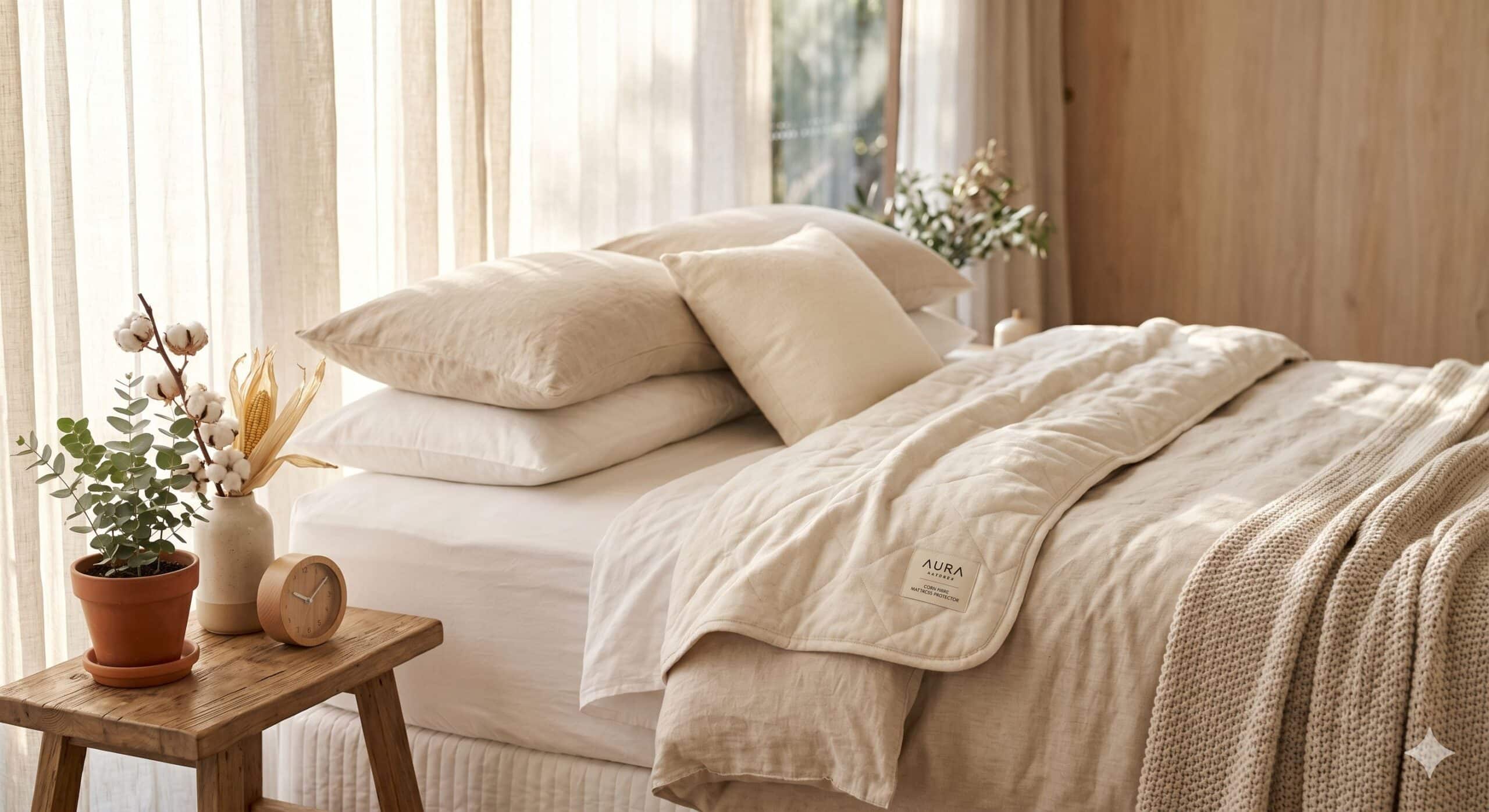
A mattress protector is the layer between your body and your mattress. It handles the moisture, heat, and wear that would otherwise degrade your mattress from the first night. Most people know they need one — but few realise how much the material choice affects how they sleep.
Conventional waterproof mattress protectors are made from PVC or vinyl. They work. They keep moisture out. They also trap heat, make noise when you move, and off-gas chemicals that you breathe while you sleep. For a layer that sits directly beneath you for eight hours a night, that’s a significant compromise.
Corn fibre protectors — made from polylactic acid (PLA) derived from corn starch — are waterproof and breathable. No crinkle sound. No heat trap. No synthetic chemical off-gassing. This page explains the difference in detail and helps you choose the right natural mattress protector for your bed.
A good mattress is an investment — often the most considered purchase in a bedroom. An organic latex mattress in particular represents a significant outlay and is designed to last 20 years or more. Without a protector, that mattress is exposed nightly to sweat, skin cells, body oils, and the occasional spill. These degrade foam and latex over time, and they void most mattress warranties.
A mattress protector solves this. It adds a cleanable barrier that takes the daily wear so your mattress doesn’t have to. You wash the protector; the mattress stays clean.
But here’s the problem: most people put a waterproof protector between themselves and an otherwise carefully chosen mattress — and the protector undoes much of what the mattress was selected to do. A latex mattress chosen for its breathability and temperature regulation becomes hot and noisy the moment a PVC protector goes on top. You’ve protected the investment but degraded the sleep experience.
A natural mattress protector solves both problems — protecting the mattress without changing the sleeping environment you paid for.
PVC (polyvinyl chloride) and vinyl are the most common waterproofing materials in the mattress protector market. They are cheap, effective at blocking liquid, and widely available. They are also among the least comfortable materials to sleep on or near.
PVC is impermeable. It blocks liquid because nothing passes through it — including air. That impermeability, which makes it waterproof, is exactly what makes it a heat trap. Your body heat radiates downward during sleep, and a PVC layer reflects it back. The result is a warmer, clammier sleeping environment, particularly pronounced in Australian summers.
Anyone who has slept on a PVC mattress protector is familiar with the noise. The material crinkles and shifts with every movement. For light sleepers, this is genuinely disruptive. For partners sharing a bed, it amplifies every movement.
PVC requires chemical plasticisers — most commonly phthalates — to remain flexible. These compounds are volatile organic compounds (VOCs) that off-gas from the material, particularly when warmed by body heat. The new plastic smell of a PVC protector is those chemicals entering the air. While PVC protectors in Australia must comply with safety standards, the presence of phthalates in a material you sleep on nightly is a reasonable concern, particularly for infants and children.
If you have chosen a natural latex mattress or a high-quality organic mattress for its breathability and feel, placing a PVC protector over it is counterproductive. The protector traps the heat and moisture the mattress was designed to release, and can create a microclimate between the protector and the mattress that accelerates the degradation of latex and other natural materials over time.
Corn fibre mattress protectors use a membrane made from polylactic acid, or PLA — a bioplastic derived from fermented plant starch, most commonly corn. PLA is used across a wide range of applications as a more sustainable alternative to petroleum-based plastics, and in mattress protectors it provides waterproofing that is fundamentally different in character from PVC.
PLA membrane is microporous — engineered with pores small enough to block liquid water molecules but large enough to allow water vapour (the moisture from your body heat and perspiration) to pass through. This is the same principle used in technical outdoor fabrics like Gore-Tex. Liquid spills are blocked; body moisture is released.
The result in practice: you get full liquid protection without the heat trap. A corn fibre protector on a natural latex mattress preserves the breathable sleep environment the mattress was designed to provide.
PLA membrane is softer and more pliable than PVC. A quality corn fibre protector is quiet under movement — you won’t hear it when you or your partner shifts position during the night.
PLA does not require phthalate plasticisers to remain flexible. The membrane is stable and does not off-gas VOCs the way PVC does. A corn fibre protector can be placed on the bed and used from the first night without the chemical smell associated with PVC alternatives.
If you’ve invested in an organic latex mattress or a high-quality natural mattress, a corn fibre protector is the logical protective layer. It won’t undermine the breathability and temperature regulation that natural latex provides, the way a PVC protector would. Both layers work in the same direction.
| Corn Fibre (PLA) Protector | PVC / Vinyl Protector | |
|---|---|---|
| Waterproof | Yes — full liquid protection | Yes — full liquid protection |
| Breathable | Yes — microporous membrane | No — fully impermeable |
| Temperature regulation | Allows body heat to dissipate | Traps heat, increases surface temperature |
| Noise | Silent under movement | Crinkles audibly with movement |
| Off-gassing | None | Phthalate VOCs in early use (and ongoing) |
| Feel | Soft, undetectable under a fitted sheet | Rigid and plasticky |
| Material origin | Plant-derived bioplastic | Petroleum-derived synthetic |
| Best paired with | Natural latex, organic mattresses | Budget/synthetic mattresses |
| Certifications available | Oeko-Tex, GOTS (fabric layer) | Limited — CertiPUR-US not applicable |
| Environmental end-of-life | Compostable under industrial conditions | Non-biodegradable |
Corn fibre is the strongest combination of waterproofing and breathability, but it is not the only natural option. Depending on your priorities, the following alternatives are worth considering.
An organic cotton mattress protector without a waterproof membrane is the most breathable option of all. GOTS-certified organic cotton is grown without synthetic pesticides or fertilisers, and processed without harmful finishing agents. A cotton protector is ideal for households where liquid spills are not a significant risk — adult beds without young children, for instance — and where maximum breathability is the priority.
The limitation is obvious: cotton alone will not stop a spill from reaching the mattress. For full protection, a waterproof layer is necessary.
Some natural mattress protectors use a quilted organic wool fill between the surface fabric and the waterproof membrane. Wool adds temperature regulation — absorbing moisture vapour in warm conditions and providing insulation in cool ones — which makes a wool-filled protector useful in climates with significant seasonal temperature swings, or for sleepers whose temperature varies widely through the night.
Wool-filled protectors are thicker than standard protectors and add a slight cushioning layer to the mattress surface. Paired with a corn fibre membrane underneath, this is one of the most thermally balanced natural protector options available.
The most common construction for a quality natural mattress protector: an organic cotton surface (GOTS certified, soft against the fitted sheet) bonded to a PLA waterproof membrane underneath. This combines the familiar softness of cotton with the breathable waterproofing of corn fibre. It is the construction used in most of the natural mattress protectors we recommend at Zentai Living.
The term “natural” is unregulated on Australian product labels. A mattress protector with a cotton surface layer and a PVC waterproof membrane is still often marketed as a “cotton mattress protector” — the PVC is not prominently disclosed. Here is what to check.
Identify the waterproof layer. Ask the retailer or check the product specifications to confirm what material provides the waterproof barrier. Look for PLA, corn fibre, or thermoplastic polyurethane (TPU) — which is a step up from PVC in breathability and chemical profile, though not plant-derived. If the product lists PVC or vinyl, that is what you’re sleeping on.
Check the surface fabric certification. A GOTS certificate on the fabric layer confirms the cotton or other textile was grown and processed to organic standards. Oeko-Tex Standard 100 on the finished protector confirms the product has been tested and is free from harmful substances. Both are meaningful; neither alone tells you the full story.
Consider fit and depth. A mattress protector that doesn’t stay on the mattress doesn’t protect it. Check the pocket depth — particularly important for latex and pillow-top mattresses, which are often thicker than standard. A fitted protector with deep, elasticated sides stays in place and maintains contact across the full surface.
Match the protector to the mattress. A corn fibre protector is the right choice for a natural latex mattress. It preserves the breathability of the latex rather than working against it. If you have an organic latex mattress from Zentai Living, using a PVC protector on top is a significant compromise to the sleep environment the mattress was designed to provide.
Our natural mattress protectors are available in all standard Australian sizes:
| Size | Dimensions |
|---|---|
| Single | 92 × 188 cm |
| King Single | 107 × 203 cm |
| Double | 138 × 188 cm |
| Queen | 153 × 203 cm |
| King | 183 × 203 cm |
| Super King | 203 × 203 cm |
Custom sizes available for non-standard beds — including European and US sizes.
A corn fibre or organic cotton mattress protector is designed to be washed regularly — that is its purpose. Follow these guidelines to maintain the waterproof layer and extend its life.
Machine wash on a gentle cool or warm cycle (up to 60°C for most PLA membrane protectors — check your specific label). Avoid hot washes, which can degrade the bonding between the fabric layer and the waterproof membrane.
Do not tumble dry on high heat. A low heat or air-dry setting preserves the membrane. High heat can cause the PLA or TPU layer to delaminate from the fabric surface over time.
Do not iron. The waterproof membrane can be damaged by direct heat.
Dry fully before replacing on the mattress. Replacing a damp protector traps moisture against the mattress surface — the opposite of what a protector is meant to do. Allow the protector to dry completely, then air for a short period before making the bed.
With normal care, a quality corn fibre mattress protector should last years before the membrane begins to lose its waterproofing performance.
At Zentai Living, we’ve been making natural sleep products by hand in Byron Bay since 1981. When we sell a mattress protector, it’s because we know the material works and we stand behind what’s in it — not because a “natural” label can be applied to almost anything.
Our natural mattress protectors use [INSERT: specific construction details — e.g., GOTS-certified organic cotton surface with PLA/corn fibre waterproof membrane]. They’re the layer we recommend for our own organic latex mattresses because they protect without compromising.
When you buy from Zentai Living:
Is a corn fibre mattress protector really waterproof? Yes. The PLA membrane in a corn fibre protector blocks liquid water fully — it is rated for waterproofing against spills, sweat, and incontinence. The microporous structure that makes it breathable does not compromise its liquid protection. Water vapour molecules are much smaller than liquid water molecules; the membrane allows one through and blocks the other.
Will I feel the mattress protector under my sheets? A quality corn fibre protector with a soft organic cotton surface should be undetectable under a fitted sheet. The mattress surface feels like cotton. The noise and texture you associate with waterproof protectors are characteristics of PVC, not PLA.
Does a corn fibre protector work on a latex mattress? Yes — and it’s the recommended combination. A corn fibre protector preserves the breathability of natural latex rather than sealing it off the way PVC does. If you have an organic latex mattress and are using a PVC protector, switching to corn fibre is one of the simplest improvements you can make to your sleeping environment.
What’s the difference between corn fibre and TPU? Both are breathable waterproof membrane materials and both are better than PVC for temperature and chemical profile. TPU (thermoplastic polyurethane) is a petroleum-derived synthetic — it breathes well and has no phthalates, but it is not plant-based. PLA/corn fibre is derived from plant starch and is industrially compostable. Both are significantly better sleeping environments than PVC; corn fibre has the additional credentials of plant origin.
Can I put a mattress protector on a latex topper as well as the mattress? A protector goes on whichever sleep surface is uppermost in your bed — typically the mattress, or over a topper if you use one. If you use a latex mattress topper, the protector should sit above the topper, between it and your fitted sheet. This protects both the topper and the mattress beneath it.
How often should I wash a mattress protector? Every one to two months with normal adult use, or more frequently if the protector is on a child’s bed or if there has been a spill. Regular washing is the protector doing its job — the dirt and moisture it catches is exactly what would otherwise be going into your mattress.
Do you ship mattress protectors Australia-wide? Yes. Free delivery across Australia on all orders. [INSERT: lead time and delivery details]
What size mattress protector do I need? Match the protector size to your mattress size, and check the pocket depth against your mattress thickness. Standard pocket depths suit mattresses up to approximately 30–35cm. Our organic latex mattresses and some toppers may require a deep-pocket option — check the product listing or contact us if you’re unsure.