📢 Update: You can now contact us by landline 02 6685 6722 or Shop Mobile 0490 078 621 — available for both calls and texts.
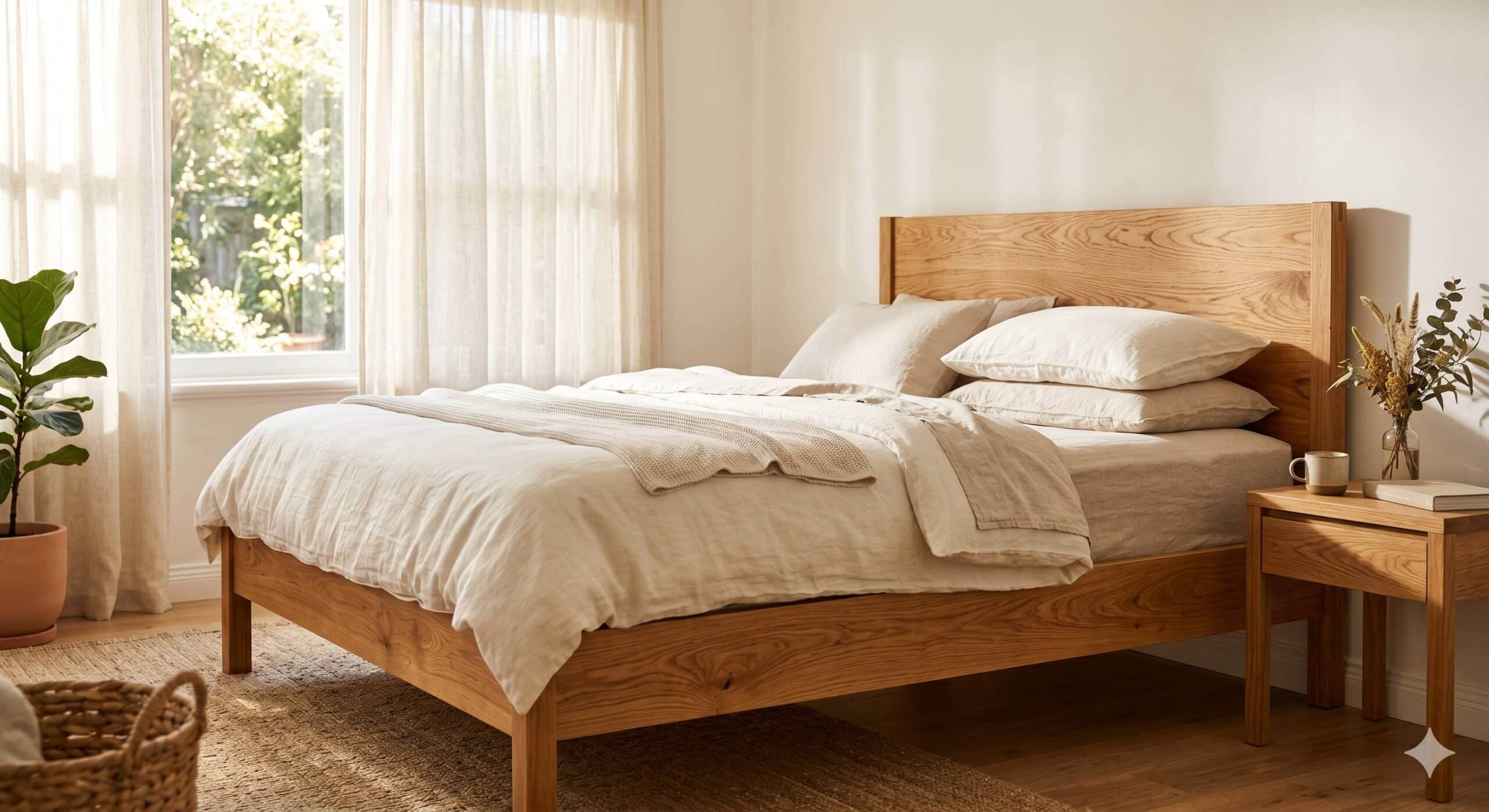
When people invest in a quality organic latex mattress, they frequently spend less time thinking about the bed frame beneath it. This is understandable — the mattress is where you sleep, where you feel the difference, where the health and comfort benefits are most immediately experienced. The bed frame, by comparison, seems structural and secondary. A platform for the mattress. A visual element. Something to coordinate with the wardrobe.
This framing understates the bed frame’s significance considerably.
The bed frame is the single largest piece of furniture in most Australian bedrooms. It occupies more visual real estate than any other element in the room. It determines the sleeping height, the airflow beneath and through the mattress, the quality of mattress support, and the acoustic and structural stability of the entire sleep system. It is present in the bedroom every hour of every day, in close proximity to the breathing space of every person who sleeps in the room. And unlike a mattress — which is encased in covers and protectors that create some barrier between its materials and the surrounding air — a bed frame is an open structure, its surfaces directly exposed, off-gassing whatever compounds its construction materials contain into the bedroom environment continuously.
For all of these reasons, the material from which a bed frame is made matters. And in the Australian bedroom furniture market, the distance between the most common materials and the best available material is larger than most buyers realise.
At Zentai Living, every bed frame we make is constructed from solid American oak with natural penetrating oil finishes. This is a deliberate, principled choice — not a style preference or a marketing position. This guide explains why, in the detail required to fully appreciate the difference.
To understand why solid American oak represents the best available choice for a natural bedroom, it helps to first understand what most bed frames are actually made from — because the answer is not what most people assume.
Medium density fibreboard — MDF — is the dominant structural material in mass-market and mid-market bedroom furniture. It is manufactured by breaking down wood residues — sawdust, wood chips, and shavings — into wood fibres, combining them with synthetic resin binders under heat and pressure, and forming them into dense, flat sheets that can be cut, shaped, routed, and finished to resemble solid timber.
MDF has genuine advantages as a manufacturing material. It is dimensionally stable — it does not warp, crack, or shrink the way solid timber can with changes in humidity. It machines beautifully, accepting precise cuts and complex shapes without the grain variation of natural timber. It is significantly less expensive than solid wood. And it can be veneered, painted, or laminated to produce surfaces that are visually indistinguishable from solid timber to most buyers.
The fundamental problem with MDF — and it is a serious one in the context of bedroom furniture — is its binder chemistry. The synthetic resin used to bond wood fibres in MDF is almost universally urea-formaldehyde (UF) resin. Formaldehyde is a confirmed human carcinogen — classified as Group 1 by the International Agency for Research on Cancer — and it off-gases continuously from UF-bonded products throughout their useful life.
New MDF furniture off-gases formaldehyde at rates that can meaningfully elevate indoor formaldehyde concentrations, particularly in enclosed spaces with limited ventilation. Emission rates decline over time but do not reach zero — a bed frame made from standard MDF will continue to release formaldehyde into the bedroom air for as long as it remains in the room. Regulatory standards in Australia set maximum formaldehyde emission limits for MDF products — but “below the regulatory limit” is not the same as “not present,” and bedroom-specific context — eight hours per night, in a room that is often poorly ventilated, with the breathing zone in close proximity to the furniture surface — creates a more significant exposure pathway than general indoor environment standards account for.
Particleboard — also called chipboard — is a lower-density engineered wood product made from coarser wood particles bonded with synthetic resin under pressure. It is lighter and less dense than MDF, machines less precisely, and is generally used for less structurally demanding applications in furniture. Like MDF, it uses urea-formaldehyde or similar resin binders, with similar off-gassing implications.
Particleboard is the dominant material in flat-pack furniture — the self-assembled beds and bedroom furniture sold through volume retailers. The thin timber veneer or melamine laminate surface applied to most particleboard furniture creates a visual impression of timber while concealing the engineered wood substrate beneath.
Much of what is sold as “timber” bedroom furniture is not solid timber in any meaningful sense — it is an engineered wood substrate (MDF or particleboard) with a thin surface layer of either real timber veneer (typically 0.6–3mm of genuine wood) or synthetic laminate (a photographic image of wood grain printed on plastic or resin-impregnated paper). Both finishes can produce a convincing visual impression of solid timber while the structural material remains engineered wood with its associated binder chemistry.
Veneer furniture is generally of better quality than laminate, as real wood veneer ages more gracefully, can be refinished, and has a more authentic surface texture. But neither veneer nor laminate changes the fundamental nature of the substrate material — and it is the substrate, not the surface layer, that contains the formaldehyde-releasing binders.
Solid timber furniture — made from boards of real wood cut from logs rather than manufactured from wood fibre composites — is the alternative to engineered wood products. Solid timber contains no formaldehyde-releasing binders. Its only significant VOC source is the finish applied to its surface — and with natural penetrating oil finishes, even this source is minimal and short-lived.
Solid timber furniture also differs from engineered wood in durability, repairability, ageing characteristics, and sensory quality — the feel of a solid timber surface, the sound it makes, its warmth to the touch, and the visual depth of its natural grain are properties that engineered wood products cannot authentically replicate at any price point.
The significant limitation of solid timber furniture is cost. Solid hardwood is more expensive than engineered wood as a raw material, more demanding to work with as a manufacturing material, and results in a product that costs considerably more to produce. This cost difference is real and should be acknowledged — but it reflects genuine differences in material quality, durability, and health profile that are meaningful over the life of the product.
Among the many timber species available for furniture making, Zentai Living uses American oak — specifically white oak and red oak grown in sustainably managed North American forests. This choice is not arbitrary. American oak has a specific combination of properties that make it exceptionally well-suited to bed frame construction in the Australian context.
Hardness in timber is measured on the Janka hardness scale — a standardised test that measures the force required to embed a steel ball to a specified depth in the wood. Higher Janka ratings indicate greater hardness and resistance to denting and wear.
American white oak has a Janka rating of approximately 6,000 newtons. This places it comfortably in the hardwood category — harder than many commonly used furniture timbers including pine (a softwood), poplar, and even some species marketed as hardwoods. For a bed frame — a piece of furniture that must bear significant and repeated load, resist the stresses of nightly use, and maintain its structural integrity over decades — this hardness is a meaningful performance characteristic.
The structural integrity of solid American oak allows Zentai Living’s frames to be constructed with genuine joinery — mortise and tenon joints, dowel connections, and bolt-through assembly rather than the cam locks and staples typical of flat-pack furniture. These joinery methods create connections that are mechanically stronger, more resistant to racking and wobble, and more repairable than the engineered fasteners used in composite wood furniture.
American oak has a distinctive open grain structure — visible pores and medullary rays that create the characteristic “cathedral” grain pattern in flat-sawn boards and the striking “ray fleck” pattern in quarter-sawn timber. This grain structure is not merely aesthetic — it reflects the cellular architecture of the wood, which contributes to its structural properties and its excellent response to penetrating oil finishes.
The open grain of oak accepts natural penetrating oils deeply and evenly, creating a finish that bonds with the wood at a cellular level rather than sitting on the surface as a film. This results in a finish that is more durable, more natural in feel, and easier to maintain and renew than surface film finishes such as lacquer or polyurethane varnish.
Oak is also an excellent timber to work with in furniture making — it cuts cleanly, joints accurately, and holds fixings reliably. The combination of hardness, workability, and grain character makes it one of the premier furniture timbers in the world, used in fine furniture making across Europe and North America for centuries.
American oak has good natural durability — resistance to decay and degradation under the conditions typical of indoor furniture use. This is relevant not because bedroom furniture is exposed to moisture in the way that outdoor timber is, but because it reflects the inherent chemical resistance of the wood’s cell structure. Timber with good natural durability is resistant to the biological degradation that causes less durable timbers to weaken and degrade over time even in dry indoor environments.
A well-constructed and properly maintained solid American oak bed frame should remain structurally sound and aesthetically beautiful for 50 years or more. This is not a marketing claim — it is a reflection of the inherent properties of the material and the track record of oak furniture in homes around the world. At Zentai Living, we regularly hear from customers who purchased their frame decades ago and have returned to buy a mattress or a new piece of furniture — not because their frame has failed, but because their needs or tastes have changed.
American oak has a warm, golden-honey tone in its natural state that deepens and enriches with age and exposure to light — a process called patination. Unlike stained or painted furniture, which fades, chips, or yellows with age, naturally oiled oak furniture grows more beautiful over time. The grain becomes more defined, the colour deepens, and the surface develops the tactile and visual richness that only genuinely aged natural timber achieves.
This ageing property is significant from a value perspective. A solid oak bed frame does not depreciate visually in the way that laminate or painted furniture does — it appreciates. The 10-year-old oak frame in a well-maintained bedroom looks better than it did when new. The 10-year-old laminate frame looks worse.
Solid timber moves with changes in humidity — it expands when humid and contracts when dry, a property called wood movement. For furniture makers, managing wood movement is one of the primary technical challenges of solid timber construction. Improperly managed wood movement can cause panels to crack, joints to open, and structures to deform.
American oak has moderate wood movement characteristics — neither the most stable nor the most reactive of common furniture timbers — and its movement is well-understood by experienced furniture makers. Zentai Living’s frames are designed and constructed to accommodate the wood movement appropriate to Australian climate conditions, using joinery methods and panel construction techniques that allow the timber to move without structural consequence.
For the Australian context — which spans everything from the tropical humidity of far north Queensland to the dry inland heat of the interior — the dimensional stability of properly constructed solid oak furniture is a meaningful practical advantage over engineered wood products, which can delaminate, swell at edges, and lose structural integrity when exposed to high humidity or moisture.
The finish applied to a bed frame is as important as the timber it protects. Conventional furniture finishes — polyurethane varnish, nitrocellulose lacquer, UV-cured acrylic — are film-forming finishes that sit on the surface of the timber rather than penetrating it. They create a hard, glossy or semi-glossy protective layer that is durable, moisture-resistant, and easy to clean. They are also significant sources of VOC emissions — both during initial application and, to a lesser degree, throughout the product’s life as the finish slowly degrades.
Penetrating oil finishes — the category we use on all Zentai Living bed frames — work differently. Rather than forming a surface film, penetrating oils are absorbed into the wood’s cellular structure, where they polymerise and harden within the timber itself. The result is a finish that is integral to the wood — that cannot peel, chip, or flake because there is no surface layer to fail. The timber feels like timber to the touch — warm, slightly textured, genuine — rather than the cool, plastic-like feel of a lacquered surface.
The natural penetrating oils used on quality furniture are typically based on linseed oil, tung oil, or similar plant-derived drying oils, often combined with natural waxes (carnauba, beeswax) and sometimes small additions of mineral driers to accelerate curing. These formulations have a minimal VOC profile compared to synthetic film finishes, and any VOC emissions are concentrated in the period immediately following application — typically during the factory finishing process, not in the customer’s home.
A Zentai Living bed frame arrives at your home with its oil finish fully cured — the oils have polymerised within the timber and the VOC-releasing phase has passed. The frame does not require “airing out” in the way that freshly lacquered or painted furniture does. The finish is complete, stable, and essentially inert from a VOC perspective.
One of the practical advantages of penetrating oil finishes is their repairability. A scratched or worn lacquer surface requires professional refinishing — sanding back the existing finish and applying a new coating, a process that is disruptive and often results in a finish that does not perfectly match the original. A scratched or worn oil finish can be repaired by cleaning the affected area and applying a small amount of the same oil — a 15-minute process that can be performed by the furniture owner with no specialist skill or equipment.
This repairability means that a Zentai Living bed frame can be maintained in excellent condition indefinitely with minimal effort and no professional intervention — contributing to the product’s effectively unlimited useful life.
Zentai Living’s bed frame range currently comprises six models, each in solid American oak with natural oil finish, available in Single, King Single, Double, Queen, and King sizes. The collection spans a range of aesthetic directions — from the floor-hugging minimalism of the Zen frame to the architectural statement of the Aura — while sharing the same fundamental material and construction commitments.
The Platform frame is the purest expression of the Zentai Living design philosophy — solid American oak, clean horizontal lines, a low-profile slatted base, and no headboard. It is the frame at its most essential: four legs, a frame, and a slatted surface designed to support a mattress with maximum airflow and minimum visual complexity. Priced from $735 to $1,325 across sizes.
The Platform suits minimalist bedroom aesthetics — Japandi, Scandi, contemporary Australian — where the bed frame is intended to be a grounded, quiet presence rather than a design statement. It pairs particularly well with our SleepMat and Essential Comfort mattress range, and with tatami mat installations where the low, horizontal emphasis of the sleeping arrangement is the design intent.
The slatted base of the Platform — as with all Zentai Living frames — is designed with slat spacing appropriate to organic latex mattress support. Slats are spaced no more than 7–8 centimetres apart, preventing any tendency for the latex to sag between supports. The slats are themselves solid timber — not the hollow or composite slats found in flat-pack frames — providing consistent, durable support across the full mattress surface.
[LINK TO SUB-PILLAR: Platform Bed Frame — Full Dimensions, Specifications & Pairing Guide]
The Samsara adds a beautifully proportioned slatted headboard to the Platform base — a headboard whose upright solid oak slat design adds vertical definition to the bedroom without imposing visually or creating the enclosed, heavy feeling of solid panel headboards. The Samsara is our most versatile and consistently popular frame, equally at home in a contemporary apartment bedroom and a more traditional home environment. Priced from $830 to $1,625.
The headboard height is calibrated to be functional — providing genuine backrest support for reading or working in bed — while remaining proportionally appropriate across all mattress sizes. The slat spacing in the headboard echoes the base construction, creating a coherent visual rhythm across the frame’s full profile.
The Samsara’s combination of complete functionality, broad aesthetic compatibility, and accessible price point makes it the natural starting point for most buyers approaching the Zentai Living frame range for the first time.
Samsara Bed Frame — Design Story, Dimensions & Specifications
The Citta introduces a footboard to the frame geometry — a lower-profile counterpoint to the headboard that creates a gentle sense of enclosure within the sleeping space. The footboard is deliberately lower than the headboard, preserving sightlines across the room while defining the bed’s territory more completely than a headboard-only design. Priced from $1,135 to $1,925.
The Citta is well-suited to master bedrooms where the bed is the focal point of a considered interior — where the frame is intended to read as a complete object rather than a headboard and base. The footboard’s lower height also makes it practical in a way that some full-footboard designs are not — it does not impede access to the bed from the foot end, and does not create the visual blockage that full-panel footboards can produce in smaller rooms.
Citta Bed Frame — Full Dimensions, Styling Ideas & Specifications
The Sienna is defined by its headboard — a tall, architecturally refined panel in solid American oak that creates a commanding focal point in any bedroom. The headboard’s generous height and considered proportions transform the bed into the undisputed centrepiece of the room, anchoring the space with a weight and authority that simpler frames cannot achieve. Priced from $1,495 to $1,825.
Despite its visual presence, the Sienna avoids heaviness through the quality of its timber selection and the refinement of its joinery details. The solid oak grain — visible and celebrated rather than hidden — gives the headboard a natural warmth that prevents the architectural scale from feeling cold or institutional. The Sienna is the frame most often chosen for master bedrooms where the client has invested in a complete interior and wants the bed to perform as the room’s defining element.
Sienna Bed Frame — Our Most Architecturally Considered Design
The Zen frame is Zentai Living’s most recent design addition and responds to a clear and growing segment of customer demand — the desire for an ultra-low sleeping position within a full bed frame structure rather than a mattress on the floor or a futon on a tatami mat. The Zen frame sits at the lowest profile in our range, creating a sleeping height that emphasises the horizontal, grounded quality of the traditional Japanese sleeping aesthetic while providing the structural convenience of a slatted timber base. Priced from $1,295 to $1,625.
The Zen frame pairs most naturally with our SleepMat or Essential Comfort mattress range — the lower profiles that suit a floor-adjacent sleeping height — and with tatami mat placement, where the frame can be positioned directly on tatami to maintain the Japanese aesthetic context while providing a slatted base for the mattress.
For bedrooms with lower ceiling heights, the Zen frame’s profile preserves the sense of vertical space that higher-profile frames can compromise. It also suits open-plan sleeping spaces and studio apartments where a lower bed height integrates more naturally with a continuous floor plane.
Zen Bed Frame — Low-Profile Sleeping, Japanese Influence & Specifications
The Aura is Zentai Living’s flagship frame — the product of the most elaborate design, the finest timber selection, and the most considered joinery in our range. Its headboard is bold, sculptural, and unmistakably a statement — an expression of what solid American oak can achieve when worked with genuine craft ambition rather than production efficiency as the primary consideration. Priced from $1,895 to $2,225.
The Aura is built to a standard that transcends furniture and approaches heirloom. Every element — the selection of particularly figured oak boards, the joinery details, the oil finishing — reflects an investment of skill and material that is visible in the finished product and perceptible in daily use. It is the frame for the bedroom that is being built to last — not for the current decade but for the decades that follow.
Customers who purchase the Aura frequently describe it as the last bed frame they expect to buy — and they mean this as the highest praise rather than a resignation. That durability of intention is the true value of the product.
Aura Bed Frame — Premium Craftsmanship, Materials & Care
The market for “timber” and “solid wood” bed frames in Australia is not always what it appears to be. The following guidance will help you evaluate any timber bed frame claim with appropriate rigour — whether from Zentai Living or any other supplier.
This is the first and most important question. “Timber bed frame” is a broad category that encompasses everything from solid hardwood through to particleboard with a thin timber veneer. Ask specifically: is the structural material solid timber throughout? Is the headboard solid timber or a timber veneer over an MDF substrate? Are the legs solid timber? Are the rails solid timber?
The answers should be specific and verifiable. If the response is vague — “it’s a wood frame” or “it’s made with timber materials” — ask again more specifically. A genuinely solid timber frame will come with a straightforward answer about the species and construction.
How is the frame assembled? This question reveals a great deal about construction quality. Solid timber frames can be joined in several ways of varying quality:
Mortise and tenon joints — where a projecting tenon cut from one piece of timber fits precisely into a corresponding mortise in another — are the traditional benchmark of quality furniture joinery. They create a mechanical connection that is exceptionally strong in the directions most relevant to bed frame stress — lateral racking and vertical load.
Dowel joints — where cylindrical wooden dowels are glued into corresponding holes in both parts — are a competent alternative to mortise and tenon, commonly used in quality production furniture.
Bolt-through connections — where threaded steel bolts connect structural components — are appropriate for the connections that must be disassembled for moving or relocation, and are used in Zentai Living frames at the rail-to-leg connections for this reason. They should be used in conjunction with quality joinery at other connections, not as a substitute for it.
Cam locks and dowel pins — the standard assembly hardware of flat-pack furniture — are adequate for the light loads of flat-pack applications but are not appropriate for quality solid timber furniture. A solid timber frame assembled entirely with cam locks is overengineered in its material and underengineered in its joinery.
The slatted base is a critical functional component that is often overlooked in bed frame evaluation. Key questions:
Are the slats solid timber or hollow? Hollow slats, common in some flat-pack frames, have less structural integrity under sustained load and may flex or deform over time.
How many slats are there, and what is the spacing? For organic latex mattresses, slat spacing should not exceed 7–8 centimetres. Wider spacing allows the latex to sag between supports, reducing mattress performance and longevity.
Are the slats fixed or sprung? Sprung slats — curved slats mounted in rubber holders that flex under load — add a degree of suspension to the sleeping system. Fixed flat slats provide a firmer, more stable base. Both are appropriate depending on the mattress type; organic latex mattresses generally perform well on either, though fixed slats are the simpler and more durable option.
What finish has been applied, and what does it contain? For a bedroom environment prioritising natural materials, the appropriate answer is a penetrating oil or wax finish with minimal or no synthetic additives. A lacquer or polyurethane finish is not wrong — it is durable and practical — but it introduces a synthetic surface chemistry and a VOC-releasing phase that natural oil finishes avoid.
Can the finish be renewed or repaired at home? This is the practical durability test. A penetrating oil finish can be locally repaired by the owner. A lacquer finish requires professional refinishing when damaged.
A bed frame does not exist in isolation — it is part of a sleep system that includes the mattress, the mattress protector, the bedding, and the room environment. The best bed frame is the one that best serves the total system.
For a Zentai Living organic latex mattress, a Zentai Living solid oak frame is the designed system partner — the slat dimensions, spacing, and clearances are calibrated to the mattress dimensions and performance requirements. Using a third-party frame with a Zentai mattress is entirely possible and often works well, but verifying slat spacing and base height compatibility is worth doing before purchase.
For buyers whose purchasing decisions include environmental considerations — and we believe this is a growing and important segment of the Australian bedroom furniture market — the environmental profile of solid American oak furniture is worth examining directly.
American oak is sourced from temperate hardwood forests in the eastern United States — predominantly from states including Pennsylvania, Ohio, Kentucky, Tennessee, and the Appalachian region. These forests are managed under certification schemes including the Forest Stewardship Council (FSC) and the Sustainable Forestry Initiative (SFI), which require harvesting rates that do not exceed forest growth rates, protection of biodiversity and watershed values, and regeneration requirements for harvested areas.
The result is a raw material sourced from a genuinely renewable forest resource — one where the stock is being maintained or increased rather than depleted. This is meaningfully different from tropical hardwoods, which may be sourced from forests subject to ongoing deforestation pressure, or from plantation timbers whose monoculture management may compromise biodiversity and soil health.
Timber is a carbon-storing material — the carbon dioxide absorbed by the tree during its growth is locked into the wood structure and remains stored there for the life of the product. A solid oak bed frame that lasts 50 years is a long-term carbon store — sequestering the carbon captured during the tree’s growth for half a century before any end-of-life consideration arises.
This carbon storage property is a genuine environmental advantage of solid timber furniture over both engineered wood products (where the carbon storage is similar but the binder chemistry adds a chemical burden) and metal or plastic furniture (which does not store biological carbon and whose production is more energy-intensive).
The most significant environmental advantage of solid American oak furniture is its longevity. An oak bed frame built to last 50 years represents one furniture purchase, one manufacturing event, and one transport cycle over that period. A flat-pack frame replaced every 8–10 years represents five or six manufacturing and transport cycles over the same period. The cumulative environmental cost of repeated replacement — materials, energy, transport, and end-of-life disposal — substantially exceeds the environmental cost of a single quality product produced with durable natural materials.
In this context, the premium price of solid oak furniture is not only a quality investment but an environmental one — buying quality once is almost always preferable to buying average repeatedly, both financially and environmentally.
At end of life, solid oak furniture can be sold second-hand, donated, repurposed, or broken down for use as garden timber, firewood, or raw material for other wood products. It is entirely biodegradable and leaves no persistent synthetic residue. This is in stark contrast to MDF and particleboard furniture — whose formaldehyde-based binders create challenges for recycling and composting — and to metal and plastic furniture whose end-of-life processing is more energy-intensive.
Is American oak sustainably sourced? Yes. Our American oak is sourced from sustainably managed forests in the eastern United States under FSC or equivalent certification schemes. The temperate hardwood forests of the eastern US are among the best-managed timber resources in the world, with harvesting rates consistently below growth rates and strong regulatory frameworks for forest protection.
Will the timber crack or warp in the Australian climate? Properly constructed solid timber furniture accommodates normal seasonal wood movement without cracking or warping. Our frames are designed and built with wood movement in mind — joints and panel constructions allow the timber to expand and contract with humidity changes without structural consequence. In extreme environments — particularly in Far North Queensland or arid inland regions — it is worth discussing your specific climate with us to ensure the appropriate construction approach.
How do I care for the oil finish? Oil-finished oak requires minimal maintenance. Wipe with a slightly damp cloth for cleaning — avoid harsh detergents or abrasive cleaners. Every two to three years, or when the surface begins to look dry or dull, apply a thin coat of the same penetrating oil used in the original finish, allow it to absorb for 15–30 minutes, and wipe off the excess. This 15-minute process will restore the finish to its original depth and protection. We are happy to advise on appropriate maintenance oils on request.
Can I get a custom size? Our standard range covers all common Australian mattress sizes — Single, King Single, Double, Queen, and King. For non-standard dimensions, please contact us to discuss custom sizing options. As a maker rather than a mass retailer, we have more flexibility than most on custom dimensions.
How long does delivery take? Delivery timeframes vary by location and frame model. Some frames are held in stock; others are made to order. Contact us for current availability and lead times. For Byron Bay and Northern Rivers region customers, Michael offers personal delivery and assembly.
How does a Zentai frame compare to furniture from major retailers? The comparison is difficult to make on a like-for-like basis because the products are genuinely different. A Zentai solid oak frame is a different class of product from the timber-effect furniture sold by major volume retailers — different material, different construction, different longevity, and a different health profile. The price reflects this. What we can say confidently is that over a 20-year period, the real cost of a Zentai frame — purchase price amortised over its useful life, plus the health and environmental value of its natural material profile — compares very favourably with the cycle of replacement furniture that characterises most volume retail purchases.
A solid American oak bed frame from Zentai Living is not simply a piece of furniture. It is the structural foundation of a sleep environment built on natural materials, honest craftsmanship, and a genuine commitment to your long-term health and wellbeing. It is the frame you buy once, maintain simply, and pass on.
We invite you to visit our Byron Bay showroom and experience the frames in person — to run your hand across the grain of naturally oiled oak, to feel the solidity of properly joined timber, and to understand in your body rather than your mind what the difference between genuine quality and its simulation feels like.
Visit our showroom: 1/8 Banksia Drive, Byron Bay NSW 2481 Call or text: +61 2 6685 6722 | 0490 078 621 Email: [email protected] Shop online: zentai.com.au/product-category/bed-frames